ONCF–Maersk: A Partnership to Develop Containerized Rail Freight in Morocco
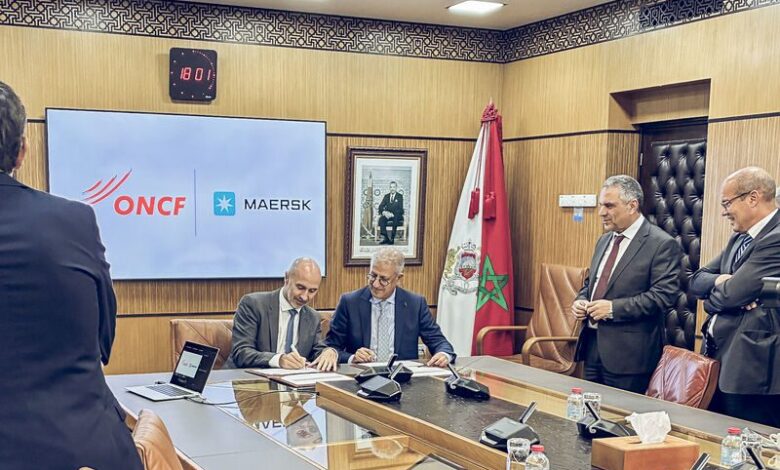
ONCF and Maersk Sign Agreement to Enhance Container Rail Transport in Morocco
The National Office of Railways (ONCF) and the Danish group Maersk have signed a memorandum of understanding aimed at exploring the development of container rail transport in Morocco. This initiative seeks to strengthen connections between ports and major industrial and commercial hubs, integrating rail transport more fully into national and international logistics chains.
Transporting goods between ports and industrial sites is a crucial factor for the logistical competitiveness of Morocco. In this context, ONCF and Maersk have jointly engaged in discussions on new containerized rail freight solutions, which could complement the currently utilized road transport modes.
Through this memorandum, the two partners aim to examine the possibilities of shifting a portion of the freight movement toward rail, particularly on routes linking port infrastructures to industrial and commercial areas within the Kingdom.
The goal is to better integrate rail transport into the journey of imported and exported goods, proposing a more coordinated logistical organization between the various transportation modes.
Consistent Volumes: A Determining Factor
The development of containerized rail freight relies heavily on the ability to gather sufficient and consistent volumes along a single route. Consolidating containers from multiple clients would optimize the filling of trains and enhance departure frequencies.
For industrial companies and economic operators, the reliability of schedules is a crucial issue. Being able to schedule deliveries at specific times would facilitate supply management, delivery planning, and production activity organization.
Beyond pricing, the competitiveness of this solution will depend on its capacity to guarantee a regular and predictable service throughout the entire logistical journey.
Improved Coordination Between Ports, Rail, and Road
Successful containerized rail freight operations will also depend on the coordination among various participants in the logistics chain.
The availability of containers at port terminals, completing formalities before trains depart, and organizing delivery operations at destination are all factors to consider.
Transfers between different modes of transport indeed require additional handling operations. Therefore, the savings achieved during rail transport need to offset these costs and allow for competitive end-to-end delivery times.
In this framework, trains could cover the main routes between ports and inland platforms, while road transport would maintain a complementary role for pick-ups and local deliveries.
Routes and Operational Conditions Yet to Be Defined
The memorandum signed between ONCF and Maersk marks the beginning of a study phase intended to define potential routes, expected volumes, and operational modalities of the system.
Route selection will need to consider the proximity of industrial zones, the capacity to consolidate shipments, and the possibilities for returning containers. The availability of flows in both directions would favor a more efficient use of trains and help limit empty trips.
For Moroccan shippers, the benefit of this collaboration will ultimately be measured by the performance of the service throughout the entire chain, from the port terminal to the goods receiving site.
At this stage, the partnership focuses on a feasibility and development study. Thus, the selected routes, concerned volumes, and implementation timeline are still to be detailed.