Tanger Med Benefits from the Reevaluation of Global Maritime Routes
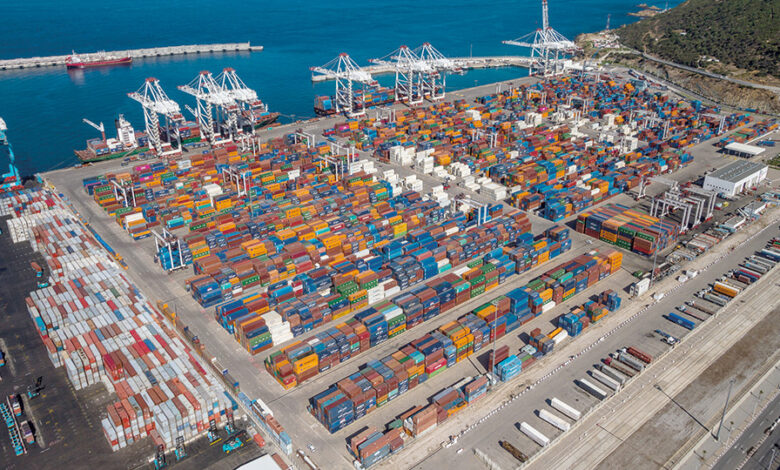
The Tanger Med port complex could benefit significantly from the reshaping of major global maritime routes driven by ongoing tensions in the Middle East. Having surpassed the threshold of 11.1 million containers processed in 2025, the Moroccan port ranks among the best-positioned platforms to capture a portion of new flows between Asia, Europe, and Africa.
In an analysis published on September 1, the Japan External Trade Organization (Jetro) highlights that Tanger Med is one of the ports likely to capitalize on the redeployment of maritime connections and the elongation of routes taken by certain vessels around the Cape of Good Hope.
Tanger Med at the Heart of New Maritime Routes
The tensions surrounding key maritime passages in the Middle East have led several shipping companies to reevaluate their rotations. A portion of international traffic is now circumventing the Arabian Peninsula, favoring longer routes around Africa before reaching Europe.
This new configuration enhances the strategic importance of Tanger Med. Located at the entrance of the Mediterranean and on one of the main routes linking the Atlantic to European, African, and Mediterranean markets, the Moroccan complex holds a favorable position for receiving and redistributing cargo.
The port can particularly serve as a transshipment platform for large container ships, facilitating the transfer of goods to smaller vessels destined for different markets. Its port infrastructure is also connected to a significant logistics and industrial ecosystem.
Over 11.1 Million Containers Processed in 2025
The performance recorded in 2025 already reflects the rising prominence of Tanger Med. Its four container terminals handled 11,106,164 TEUs, representing an increase of 8.4% compared to 2024 when traffic was approximately 10.24 million TEUs.
The overall tonnage processed by the complex reached 161 million tons, marking a 13.3% increase year-on-year. Truck traffic also saw a growth of 3.6%, totaling 535,203 units.
In total, Tanger Med recorded 16,686 port calls in 2025, including 1,319 vessels over 290 meters long, despite a 4.5% drop in the total number of port calls. This evolution notably indicates an increased presence of large-capacity ships, capable of transporting larger volumes.
Transshipment Becomes a Strategic Challenge
According to Jetro’s analysis, changes in international maritime routes could lead to an increase in the number of vessels calling at Tanger Med. The port authority has thus adapted its terminal organization to manage a potential rise in activity and mitigate congestion risks.
However, no specific figures have been provided regarding the additional port calls expected in 2026.
The challenge primarily concerns the transshipment market. The goods are not necessarily destined for the Moroccan market: large vessels may call at Tanger Med, transfer part of their cargo, and then redistribute these goods to Europe, West Africa, or other Mediterranean ports.
This hub function allows the Moroccan complex to capture a portion of international flows without solely relying on national imports and exports.
Tanger Med Among the Most Efficient Ports in the World
The competitiveness of the port is further validated by international rankings. In the 2024 Global Container Port Performance Index, published by the World Bank and Standard & Poor’s Global, Tanger Med ranks fifth globally, with an index of 135.8.
The Moroccan complex is positioned behind Yangshan, Fuzhou, Port Said, and Dalian, while notably surpassing the Spanish port of Algeciras, its direct neighbor across the Strait of Gibraltar.
This positioning enhances Tanger Med’s capacity to attract major shipping companies looking for ports that can ensure rapid operations and efficiently handle significant volumes.
The Mediterranean Repositioning Itself Amid New Routes
This phenomenon is not limited to Morocco. Jetro also notes an increase in transshipment activities at several Turkish ports, namely Kocaeli, Aliaga, and Tekirdag. These platforms are also benefiting from the reorganization of maritime networks and the choices made by companies in the context of evolving costs and international regulations.
However, Tanger Med holds a unique geographical advantage. Its location allows it to receive flows from the Atlantic, Northern Europe, West Africa, and the southern part of the African continent, before redistributing them to various destinations.
This diversity of corridors strengthens its role in international logistical chains and limits its dependence on a single maritime route.
A Moroccan Hub Set to Gain Even More Importance
With over 11.1 million TEUs handled in 2025, compared to 10.24 million the previous year, Tanger Med confirms its status as one of the principal port platforms in the Mediterranean and on the African continent.
The current reshaping of global maritime routes could provide the complex with new opportunities, particularly in the area of transshipment. However, the evolution of port calls in 2026 will reveal whether the current geopolitical disruptions will result in a sustained strengthening of Tanger Med’s presence in major international shipping lines.