The Grand Stadium Hassan II Enters a Critical Phase with a 92 Million Dirham Market
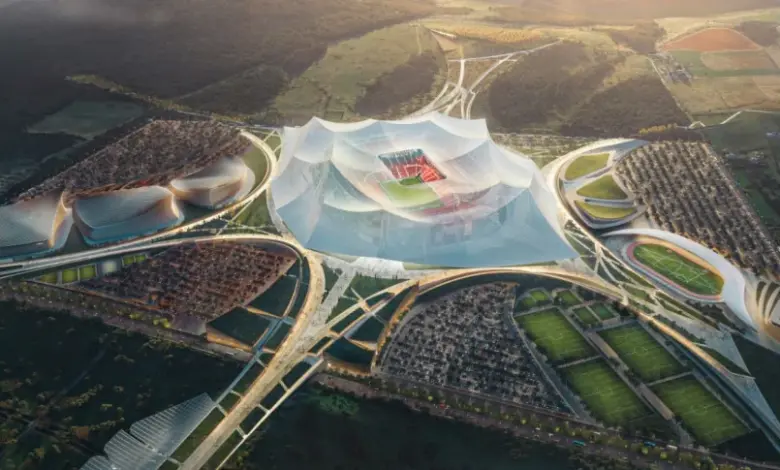
The project for the Grand Stade Hassan II, located in the Benslimane province, has reached a new milestone with the launch of a tender focused on the development and installation of the pitch, marking the transition of the construction site into a phase dedicated to equipment and technical finishing.
In this context, the National Public Equipment Agency (ANEP), acting as delegated project owner, has issued an international tender for the eighth lot concerning the playground development works of the large sports complex in Casablanca. The National Company for the Realization and Management of Sports Equipment (Sonarges) is involved as the project owner.
The estimated contract value is approximately 92.47 million dirhams, with an execution period set at 14 months from the notification of the order to proceed. The contract also includes a provisional guarantee of one million dirhams, a retention of guarantee of 7%, and a definitive guarantee amounting to 3%. The warranty period after the acceptance of the work is established at 24 months.
This new phase is particularly significant, given the requirements that the pitch must meet, which is expected to endure intensive use and host high-level sporting events, especially in the context of major international competitions.
The technical specifications thus provide for the installation of a hybrid pitch combining natural grass and synthetic elements, in accordance with the standards applied to major stadiums, particularly the French and European standard NF P 90-113.
The system is not limited to the choice of grass. The playing area must be equipped with a set of systems designed to ensure its quality and availability. This includes a forced ventilation system, artificial lighting equipment to promote the growth of natural grass, as well as modern irrigation and drainage networks.
The specifications also impose strict requirements concerning the various foundation layers of the playing area. These must exhibit a minimum load-bearing capacity of 30 megapascals and undergo dynamic testing. They must also withstand the passage of a truck with an axle loaded to 13 tons, with a maximum deformation limited to two centimeters.
Beyond the sporting and technical aspects, the contract incorporates a significant environmental dimension, aiming to improve energy efficiency and resource management for the future complex.
The company responsible for the works must also contribute to obtaining the certifications for Sustainable High-Quality Infrastructures and LEED BD+C, with a minimum Gold rating.
The environmental objectives include achieving a reduction of at least 30% in energy consumption compared to conventional designs. The project also aims to utilize renewable energies to cover between 5% and 10% of its needs, as well as installing a centralized technical management system to monitor consumption and optimize the operation of various equipment.
Water management is also a significant aspect of the project. The goal is to reduce potable water consumption by at least 40%, particularly by using economical equipment and reusing rainwater and greywater, especially for irrigating areas that do not require potable water.
The environmental requirements also emphasize the use of low-carbon materials, the promotion of local products and suppliers, and conducting life cycle analyses of the materials used. The project further includes provisions for environmental and health documents related to the products, as well as the use of wood sourced from legal and certified FSC or PEFC sources.
Alongside the technical works, several measures will need to be implemented to limit the construction site’s impact, primarily through waste management, erosion and sediment control, and air quality monitoring.
The project also designates a green site manager, responsible for overseeing compliance with environmental commitments and ensuring that requirements are adhered to throughout the construction period.
Finally, the contract includes a social and economic dimension. The chosen company must dedicate at least 20% of its workforce to local workers from the Benslimane province, while prioritizing Moroccan companies and products in accordance with applicable regulations.
Additionally, the project benefits from the support of several Moroccan and international architectural, engineering, and consultancy firms, including TARIK OUALALOU Architecte, Populous, Maffeis Engineering, M-E Engineers, and Rider Levett Bucknall, with Socotec Maroc for oversight and LPEE for studies and testing.
With the launch of this new phase, the Grand Stade Hassan II is gradually moving from structural works to technical equipment and finishes that will largely determine its performance level and capacity to host international competitions.
As major sporting deadlines approach, particularly the 2030 World Cup, Morocco continues to develop a sports complex designed to international standards, with a particular focus on pitch performance, energy efficiency, resource management, and the sustainability of the infrastructure.