Throne Festival: Infrastructure Projects to Strengthen Essential Services in Fquih Ben Salah Province
Celebrating the 27th Anniversary of His Majesty King Mohammed VI: Structural Projects to Enhance Essential Services in Fquih Ben Salah Province
In honor of the 27th anniversary of His Majesty King Mohammed VI’s accession to the throne, several projects aimed at improving wastewater treatment, sanitation systems, and electrification have been unveiled across various localities in Fquih Ben Salah Province. These initiatives are designed to bolster basic infrastructure, enhance essential services, and support territorial development.
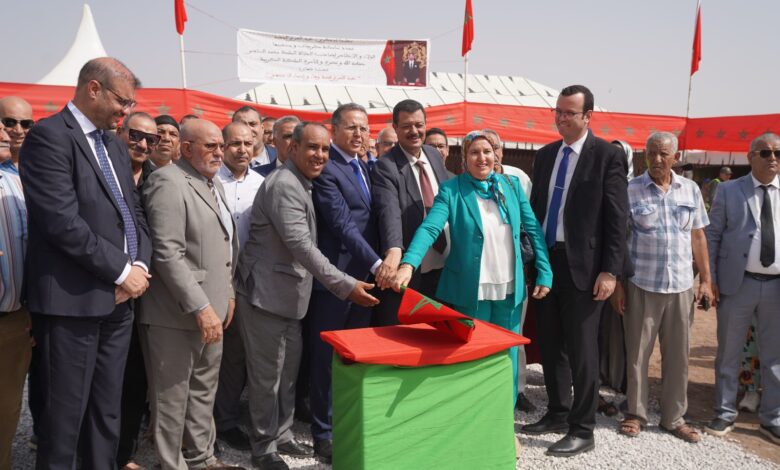
Fquih Ben Salah – The province recently held a presentation and launch of a series of key projects in the areas of wastewater management, sewage treatment, and electrification to commemorate the 27th anniversary of His Majesty King Mohammed VI’s enthronement.
Attended by the governor of Fquih Ben Salah, the general director of the Regional Multi-Service Company Beni Mellal-Khénifra, and the provincial director of the company in Fquih Ben Salah, the event also welcomed various civil and military dignitaries, local officials, and representatives from civil society.
The showcased projects include initiatives in El Khalfiya, Krifat, Souk Sebt, the industrial zone of Bradia, and the Annasr and Riyad neighborhoods in Oulad Ayad. These efforts are part of a broader strategy aimed at improving living conditions, addressing basic equipment deficiencies, and enhancing the attractiveness of the benefiting regions.
El Khalfiya and Krifat: Over 39.5 Million Dirhams for Wastewater Management
Among the critical operations is the project to establish a wastewater treatment network for El Khalfiya and Krifat, backed by a budget of 39,501,840 dirhams. This project aims to construct around 31.6 kilometers of pipelines for collecting and disposing of wastewater.
It will also include the installation of nearly 3,200 individual connections, enabling affected homes to link up with the collective sewage network. Expected to last twelve months, the project aims to enhance sanitary conditions, expand coverage of the sewage system, and reduce wastewater discharge into the natural environment.
These infrastructures will also help mitigate issues such as unpleasant odors and the proliferation of insects, while improving public health protection and safeguarding local natural resources.
Preparing Souk Sebt for Future Needs by 2050
Souk Sebt will benefit from two complementary initiatives in sewerage systems. The first involves developing a master plan for the city’s sewer system, budgeted at 1,428,000 dirhams and estimated to take twelve months.
This study will perform a detailed diagnosis of the current sewage system and outline the city’s future needs up to 2050. It will identify the most suitable technical solutions, explore various development scenarios, and establish an investment program to prioritize projects.
Thus, the master plan will serve as a crucial tool to support the demographic and urban evolution of Souk Sebt, enabling future network expansions in a coherent and sustainable manner. It will anticipate needs related to wastewater collection, disposal, and treatment to ensure that infrastructure evolves in tandem with the city.
More Than 11.4 Million Dirhams for Under-equipped Neighborhoods in Souk Sebt
The second operation focuses on connecting under-equipped neighborhoods in Souk Sebt to the sewage network. With a cost of 11,404,680 dirhams, the project plans to create approximately 17.5 kilometers of collection and discharge network, as well as nearly 2,600 individual connections.
Scheduled from June 29, 2026, to June 28, 2027, this operation will enhance the sewage system in the affected neighborhoods and eliminate certain informal or inadequate wastewater disposal methods. It will directly contribute to improved hygiene, reduced nuisances, and public health protection, while limiting soil and water resource pollution caused by uncontrolled discharges.
The establishment of this infrastructure will also coincide with urban development in Souk Sebt, thereby enhancing service quality for residents.
Bradia: A Wastewater Treatment Project in the Industrial Zone
The industrial zone of Bradia will receive a project dedicated to wastewater treatment facilities, with funding of 3,815,076 dirhams. This operation includes creating a collection and discharge network spanning 740 meters, along with 30 infiltration trenches and two sanitation installations.
Set to last from August 4, 2026, to August 3, 2027, this project aims to ensure better management of wastewater generated in the industrial area, mitigate pollution risks, and protect water resources and the surrounding spaces. It will also support the development of the industrial zone by providing the necessary infrastructure for its activities.
This initiative reflects the commitment to balancing economic development, environmental protection, and improved sanitary conditions.
Oulad Ayad: Electrification Project Impacting 762 Homes
In the electricity sector, the neighborhoods of Annasr and Riyad in Oulad Ayad will benefit from a project representing an investment of 8,300,490 dirhams. This endeavor includes connecting 762 homes to the electrical grid through the construction of seven transformation stations, three kilometers of medium-voltage network, and twelve kilometers of low-voltage network.
Scheduled for completion within twelve months, from June 12, 2026, to June 11, 2027, the project aims to improve electricity availability and provide better living conditions for the benefiting households. Access to electricity is also a vital factor in social and economic development, improving security, facilitating income-generating activities, and enhancing access to various local services.
This operation will further facilitate urban expansion in the affected neighborhoods by providing an electrical network tailored to their current and future needs.
The Regional Multi-Service Company Beni Mellal-Khénifra will also be involved in efforts in the Oulad Abdennbi area, focusing on technical studies and overseeing electrification works.
A Dynamic of Territorial Development
The introduction of these projects during the Throne Festival celebrations carries significant symbolic and territorial importance. These operations address concrete needs related to sewage management, wastewater treatment, and electricity access. They aim to enhance living conditions and strengthen the essential infrastructures required for territorial development.
Moreover, they reflect ongoing efforts to reduce disparities among various areas in the province and broaden access to quality public services. Through these projects, the actions undertaken do not merely consist of establishing networks or technical equipment; they also contribute to public health protection, environmental preservation, economic attractiveness improvement, and the creation of more favorable conditions for local development.
These investments will enable the benefiting areas to enjoy more modern, efficient infrastructures better suited for their demographic and urban evolution.