Productive Morocco: From Industry to Economic Sovereignty
Morocco’s industrial sector is scaling up. In automotive, aerospace, phosphates, agribusiness, electronics, metallurgy, cabling, and materials, production sectors are diversifying and playing an increasingly significant role in the national economy. However, behind the strong export performance, a strategic issue has emerged: what share of the created value truly remains in Morocco?
The objective is no longer merely to establish the Kingdom as a competitive industrial platform. The goal is gradually shifting towards creating a genuine space for value creation, capable of developing its own skills, suppliers, engineering, and innovation capacities.
Automotive: The Engine of Industrial Transformation
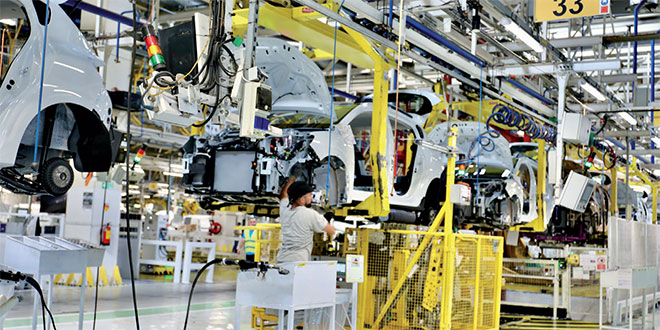
The automotive sector exemplifies this evolution particularly well. In just a few years, Morocco has become a major industrial platform and the country’s leading export sector. In 2024, automotive exports reached 157.6 billion dirhams, allowing the sector to maintain its top position for the second consecutive year.
This momentum continued into 2026. By the end of April, automotive exports had reached 58.282 billion dirhams, an 18.6% increase from the previous year, driven particularly by the performance of automotive manufacturing and cabling.
However, the real battle now lies beyond the volume of exports. The challenge is to increase the share of value produced locally through components, engineering, maintenance, logistics, training, and applied research.
A vehicle produced in Morocco represents a true industrial success only when a growing number of Moroccan companies, SMEs, technicians, engineers, and training centers are involved in its manufacturing.
An industry that assembles creates jobs. An industry that masters its value chain generates economic power.
Aerospace: Instilling a New Industrial Culture
The aerospace sector is following a similar trajectory, but with even higher requirements. This sector relies on strict standards, international certifications, and a strong emphasis on quality and traceability.
By the end of April 2026, Moroccan aerospace exports reached 11.039 billion dirhams, marking a 15.9% increase, particularly thanks to assembly and the EWIS segment.
The importance of this industry is not only measured by its contribution to exports. It also plays a role in fostering a genuine industrial culture based on precision, technical training, compliance, and process control.
Aerospace factories do not just produce parts for international markets. They also contribute to training a new generation of industrial skills.
Phosphates: From Resource to Knowledge
The phosphate sector represents another dimension of Morocco’s productive strategy. In a context where food security is becoming a major geopolitical issue, fertilizers are now a strategic product.
In 2025, the OCP Group achieved a revenue of $12.27 billion, with EBITDA of $4.62 billion and capital expenditures of $3.65 billion.
But here too, the issue transcends merely exporting a raw material. The transformation of phosphate into fertilizers, the development of agricultural solutions, agronomic research, and support for African agriculture are enabling Morocco to gradually move up the value chain.
This strategy also links industry, agriculture, food security, and South-South cooperation. The industrial product thus becomes a tool for economic partnership and development.
Producing More, but Above All, Producing Better
However, productive Morocco does not rest solely on a few major sectors. Automotive, aerospace, phosphates, agribusiness, textiles, electronics, and metallurgy are the various components of the same industrial system.
The challenge now is to strengthen connections between these sectors, develop local suppliers, and allow Moroccan SMEs to integrate more fully into the value chains.
This evolution is all the more necessary as external trade figures demonstrate ongoing vulnerabilities. By the end of December 2025, Morocco’s goods exports had reached 469.075 billion dirhams, a 2.8% increase. Meanwhile, imports had climbed to 822.223 billion dirhams.
Morocco is thus exporting more, but it is also continuing to import heavily. The challenge of productive sovereignty remains largely open.
Trade Deficit as a Strategic Signal
The trade deficit is not merely a numerical data point. It also reveals the necessity to continue efforts in local production and upgrading.
This involves developing Moroccan suppliers, strategically substituting certain imports, fostering industrial innovation, and supporting SMEs. Vocational training and universities must also be more closely linked to the actual needs of businesses.
The industrial competitiveness of the 21st century is no longer just based on labor costs. It depends on qualifications, engineering, robotics, software, data, maintenance, and the ability to produce quickly at a high level of quality.
Skills at the Heart of Industrial Morocco
Ultimately, the question of skills will dictate the next stage of Morocco’s industrial development.
An economy capable of attracting factories but that does not sufficiently master engineering, technology, and associated services risks remaining confined to subcontracting.
Conversely, an industry that develops its own skills, suppliers, research offices, research centers, and technological solutions can gradually gain autonomy and add value.
Thus, Morocco’s true challenge is no longer just to become an industrial platform. It is to build a productive ecosystem capable of creating more value locally and transforming competitiveness into economic sovereignty.