Current Accounts, Savings Accounts: The True Cost of Dormant Money
While Banks Report Strong Results, Households Face a Silent Financial Reality
As banks post comfortable earnings and Bank Al-Maghrib adjusts its monetary policy tools, another, quieter reality is unfolding within household bank statements. Hundreds of billions of dirhams remain stashed away in non-interest-bearing checking accounts or savings instruments that struggle to generate any meaningful returns.
For executives, liberal professionals, and parts of the urban middle class, the absolute security offered by checking accounts is becoming an increasingly costly comfort. Sure, money is readily available there. But it isn’t working for them. When inflation is taken into account, it may even be quietly losing value.
Billions in Dormant Savings
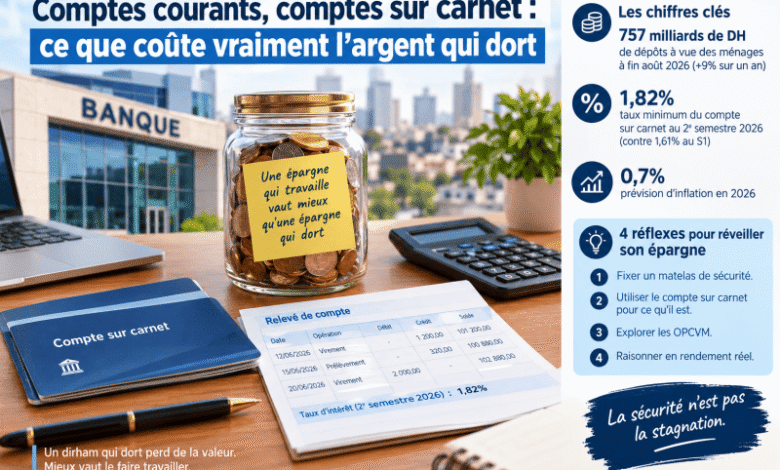
The monetary statistics from Bank Al-Maghrib affirm this observation. The liquidity reflex is deeply ingrained. By the end of August 2026, household checking account deposits with banks reached around 757 billion dirhams, an increase of 9% year-on-year.
These instantly accessible funds typically earn no interest. However, they serve as a critical resource for credit institutions, providing stable and inexpensive financing that supports their lending activities.
The paradox lies here: Savers leave their money available to banks, which, in turn, transforms it into financing capacity, intermediation margins, and ultimately, net banking products. Meanwhile, customers generally receive no interest in return.
Savings Accounts: A Low-Return Refuge
When savers move their funds away from checking accounts, the passbook savings account remains their primary refuge. However, its official yield remains modest. For the second half of 2026, Bank Al-Maghrib set the minimum applicable rate for passbook savings accounts at 1.82%, up from 1.61% in the first half.
On an investment of 100,000 dirhams over one year, this generates about 1,200 dirhams net. While this is a tangible amount, it is limited when viewed against a household’s financial goals: saving for a home purchase, funding education, preparing for retirement, or protecting against job-related uncertainties.
Inflation remains contained, with forecasts suggesting around 0.7% for 2026, following a backdrop of still-sensitive prices for essential expenses. After accounting for taxes and inflation, the real return on passbook savings accounts may remain slightly positive on a national average. Yet, this is only the case if the actual inflation experienced by a household does not exceed this threshold.
Because averages can obscure individual situations. A household facing increases in rent, healthcare costs, schooling, or transportation is not living with the aggregate inflation published by the National Institute of Statistics. They experience their own inflation.
The Invisible Tax of Liquidity
Consider a simple example: An executive has 200,000 dirhams in their checking account, exceeding any reasonable precautionary reserve. Each year, this amount produces nothing.
The checking account functions as a medium for payments, receipts, and everyday expenses. It is not meant to serve as the default vault for a savings portfolio. When liquidity consistently exceeds operational needs, it shifts from being prudent to merely inert.
The low return on liquid savings is not merely a technical inevitability; it also stems from a mindset that views checking accounts as investments, when they are anything but.
Banks have little interest in systematically guiding their clients toward reallocation. Low-cost checking deposits enhance their funding conditions. Thus, for the saver, the issue is not to abruptly exit from liquidity but rather to prioritize it. A portion should remain immediately accessible, while the surplus can be directed toward more suitable options aligned with their financial horizons and risk appetites.
Four Strategies to Revitalize Savings:
- Establish a safety cushion.
- Use the passbook savings account for its intended purpose.
- Explore mutual fund options.
- Think in terms of real returns.
The essential message is encapsulated in one sentence: Safety does not equate to stagnation. Maintaining liquidity is a management decision. Allowing substantial sums to languish in a non-interest-bearing account year after year often indicates a failure to take action.
The challenge lies not only in encouraging households to save but also in teaching them to differentiate between money meant for spending, money intended for security, and money set to work. For an idle dirham does not remain neutral; it slowly but surely loses its purchasing power.