Green Hydrogen: A Corridor Between Jerada and Nador West Med
A Study on the Feasibility of a Green Hydrogen Corridor in Northeastern Morocco
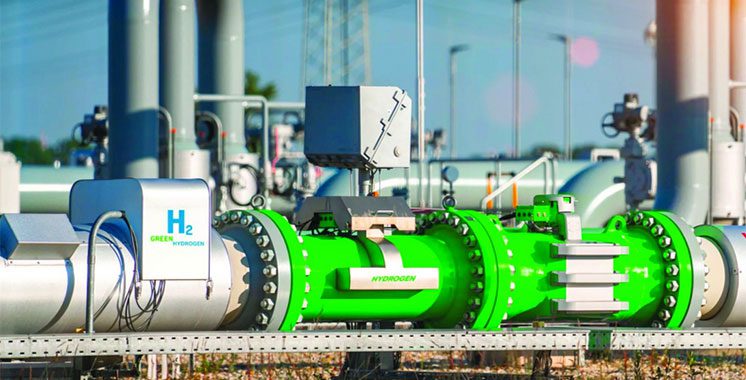
A scientific study published on October 15, 2026, in the journal E3S Web of Conferences, investigates the technical and economic feasibility of a green hydrogen supply chain connecting Aïn Bni Mathar, in the Oriental region, to the Nador West Med port complex. The model analyzed is based on utilizing photovoltaic solar energy and seawater, aiming to link inland energy resources with the industrial and port infrastructures along the Mediterranean.
An Energy Model Linking the Oriental to the Mediterranean
The study, published by EDP Sciences, was conducted by researchers Mostafa Chouitar, Alae Azouzoute, Mohammed Benhaddou, Khadija Mesmar, Dris Bahia, and Salah Daoudi. It examines a hybrid configuration designed to produce green hydrogen in northeastern Morocco by leveraging the high solar insolation of the Oriental plateaus along with access to seawater on the Mediterranean coast.
The proposed system revolves around several critical components, including photovoltaic electricity production, the treatment of water necessary for electrolysis, and the transmission of energy between various sites. Therefore, the project’s economic viability would hinge on managing these costs and evaluating the technical characteristics of the energy corridor.
The findings appear in volume 747 of the journal, dedicated to contributions from the fourth German-African Forum on Green Hydrogen, held on September 24-25 in El Jadida. It’s important to note that these works represent a preliminary scientific assessment and do not imply that an investment decision has been made.
Aïn Bni Mathar: A Site with Existing Energy Infrastructure
The choice of Aïn Bni Mathar is grounded in its territory, which already possesses an established experience in electricity generation from various energy sources.
The locality is home to a power plant that commenced operations in May 2010, boasting a total capacity of 472 megawatts. According to the African Development Bank, this facility operates on a combined cycle technology that integrates solar, gas, and steam. It includes a thermodynamic solar component of 20 megawatts, separate from the photovoltaic technology selected in the study focused on green hydrogen.
Furthermore, the plant is connected to the Maghreb-Europe gas pipeline, whose operations were suspended by Algeria in October 2021. In July 2022, the National Office for Electricity and Drinking Water (ONEE) and the National Office of Hydrocarbons and Mines (ONHYM) recommissioned this infrastructure to transport liquefied natural gas purchased from international markets, regasified at Spanish terminals, and then transported in reverse flow.
This energy experience and the presence of existing infrastructure provide essential context for analyzing a potential green hydrogen production corridor. However, it does not determine the technical feasibility or profitability of the proposed new model.
Nador West Med: A Strategic Industrial and Port Outlet
At the opposite end of the envisioned corridor lies Nador West Med, a port complex designed to accommodate maritime, industrial, logistical, and energy activities.
The public company responsible for its development and management plans to create industrial, logistical, and service zones near the port. The project is part of a broader strategy to bolster Morocco’s infrastructure and attract new industrial investments.
The complex represents a public and private investment estimated at 51 billion dirhams. Its first phase is expected to handle up to five million containers and 35 million tons of liquid and solid bulk annually, according to the project’s outlined capacities. The facility was projected to be operational by the fourth quarter of 2026.
The energy component also includes the installation of the Kingdom’s first liquefied natural gas terminal, with a projected capacity of five billion cubic meters per year. This project anticipates a connection to the Maghreb-Europe gas pipeline and an extension toward the industrial zones of Kenitra and Mohammedia.
However, the Ministry of Energy Transition and Sustainable Development suspended the tender for the first phase of this gas project, estimated at one billion dollars or approximately nine billion dirhams, on February 3. This decision was justified by the need to consider new parameters and hypotheses.
The coexistence of port, industrial, and energy projects at Nador West Med could create a conducive environment for exploring new energy pathways. However, the realization of a green hydrogen corridor would require further evaluations concerning infrastructure, transportation costs, and commercial outlets.
Morocco’s Current Green Hydrogen Focus is on Southern Regions
The proposed corridor between Aïn Bni Mathar and Nador West Med is contextualized by the fact that the initial major projects under Morocco’s Green Hydrogen Initiative are primarily concentrated in the southern regions.
Launched by a government circular on March 11, 2024, this initiative aims to attract investors towards the production of green hydrogen and its derivatives, notably ammonia, industrial fuels, and green steel.
On March 6, 2025, the steering committee of the initiative selected five investors for six projects, representing an announced investment of 319 billion dirhams in the three southern regions. These projects are expected to mobilize large land areas, approximately 30,000 hectares each, according to reported information.
Among the selected investors is the ORNX consortium, which includes American firm Ortus, Spanish company Acciona, and German firm Nordex, alongside Moroccan group Nareva and Saudi ACWA Power.
These projects complement two agreements signed in October 2024 in Rabat during French President Emmanuel Macron’s state visit, one with TotalEnergies and the other between the OCP group and Engie.
Thus, the study focusing on the Oriental region opens up additional avenues for reflection on the location of future green hydrogen production infrastructures in Morocco. However, it does not indicate that the region has been chosen for an industrial project under the Green Hydrogen Initiative.
Water Availability: A Major Challenge for Green Hydrogen
Beyond the production of renewable electricity, water availability presents one of the primary technical and economic challenges in the production of green hydrogen.
Electrolysis demands water that meets high purity standards to protect equipment and ensure the efficient operation of electrolyzers. In a country facing water stress, resorting to seawater and desalination technologies thus represents a crucial challenge for projects located near the coast.
A study published in September in the journal Renewable and Sustainable Energy Reviews specifically examines the use of reverse osmosis followed by electrodialysis to obtain water suitable for electrolyzer requirements. This research pertains to another Moroccan site, based on technical and financial assumptions specific to that study.
For the corridor envisioned between Aïn Bni Mathar and Nador West Med, integrating seawater into the model necessitates assessing desalination needs, the energy consumption required for treatment, transport infrastructure, and any potential environmental impacts.
Ultimately, the feasibility of this supply chain will depend on the balance between the costs of renewable electricity, water treatment, and the expenses necessary for transporting energy or hydrogen between sites.
At this stage, the study provides a scientific basis for examining the potential of a green hydrogen supply chain in northeastern Morocco. However, advancing to an industrial phase will require thorough technical and financial studies, alongside investment decisions and the establishment of the necessary infrastructures.